
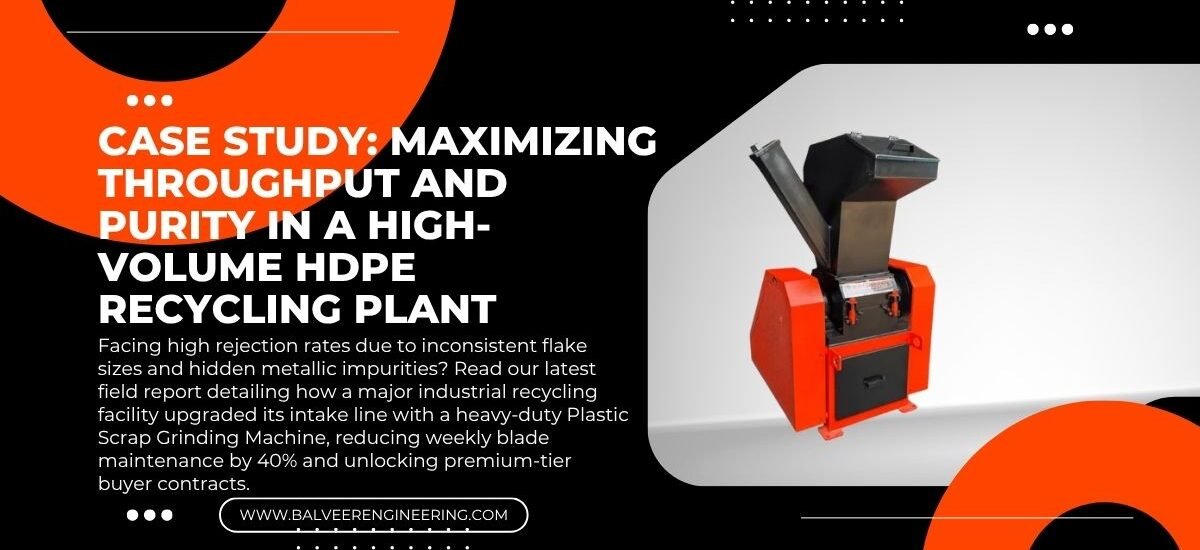
The Challenge: High Rejection Rates and Blade Failure
A prominent industrial recycling company specializing in post-consumer HDPE drums and blow-molded containers was facing severe operational bottlenecks. Their existing single-stage size-reduction line was struggling to process thick-walled scrap uniformly.
The plant was experiencing three major issues:
- Inconsistent Flake Geometry: Soft, flexible labels were stretching rather than cutting, leading to irregular flake sizes that clogged downstream washing screens.
- Rapid Blade Dulling: Processing dense, un-shredded profiles caused severe amperage spikes, forcing maintenance teams to shut down the main Plastic Scrap Grinding Machine twice a week for blade sharpening.
- Downstream Rejections: Micro-contamination from unstripped adhesives and embedded fines meant their final output was being downgraded by premium compounding buyers.
The Solution: Upgrading to a Precision Cutting Chamber
Engineers audited the plant’s intake line and implemented a complete workflow redesign centered around advanced cutting geometry and a tailored rotor configuration.
- Step 1: Staggered V-Shape Rotor Installation: The old flat-blade setup was replaced with a heavy-duty, high-speed Plastic Scrap Grinding Machine featuring a staggered V-shape chevron rotor. This changed the mechanical force from a blunt impact to a highly efficient, continuous scissoring action.
- Step 2: Dual-Stage Clearance Calibration: The rotor-to-bed knife clearance was locked in at a precise tight tolerance specifically calibrated for high-density polymers, ensuring clean cuts with minimal frictional heat.
- Step 3: Integrated Magnetic Separation: A high-intensity magnetic conveyor grid was positioned directly over the feed hopper to catch tramp metal pieces before they could reach the cutting chamber.
The Concrete Results
After 90 days of continuous operation with the newly optimized size-reduction setup, the facility recorded measurable improvements across all production metrics:
| Performance Metric | Before Optimization | After Balveer Engineering Upgrade |
| Hourly Output Throughput | 800 kg / hr | 1,250 kg / hr (56% Increase) |
| Blade Sharpening Intervals | Every 3 to 4 days | Every 18 to 21 days |
| Fines & Dust Waste | 8.2% total volume | Less than 1.5% total volume |
| Final Batch Purity Rating | 94% (Utility Grade) | 99.6% (Premium/Grade-A) |
The Financial Takeaway: Higher ROI
By achieving a uniform 10mm flake size without thermal degradation or dust buildup, the plant’s downstream high-speed friction washers and centrifugal dryers operated at peak efficiency. The final, pure HDPE flakes completely eliminated buyer rejections, allowing the company to command a 22% price premium per ton in the market.
Conclusion: Engineering Dictates Profitability
This turnaround proves that scaling a recycling business isn’t just about moving more material—it’s about optimizing the mechanical processing at the very first point of contact. Investing in a robust, correctly configured size-reduction system preserves your machinery’s life and guarantees the purity that high-end manufacturing demands.



 Users Today : 12
 Users This Month : 556
 Total Users : 3477