
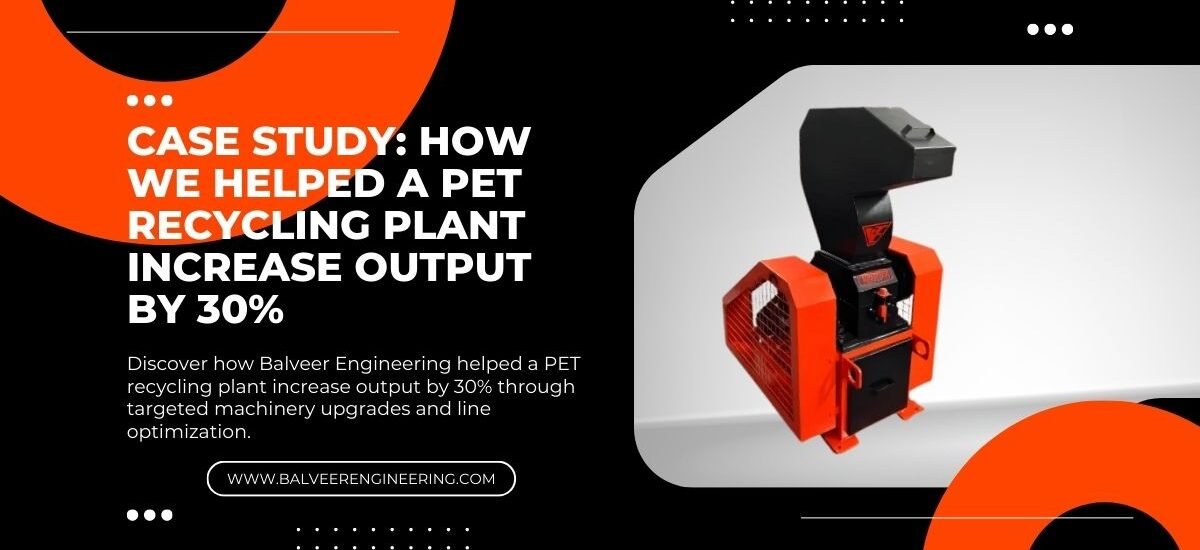
In the competitive world of plastic recycling, throughput is profit. Recently, we partnered with a recycling facility that was facing a classic bottleneck: their primary grinder was struggling to keep up with their washing line, causing frequent, costly downtime.
In this edition of our Case Studies & Results series, we explore how a targeted machinery upgrade transformed their production efficiency.
The Challenge: The Bottleneck Effect
Our client, a PET bottle processor, was seeing inconsistent flake quality and throughput drops whenever they switched between different bottle densities. Their existing system was causing:
- Bottlenecks: The grinding stage could not process material fast enough to feed the dryer.
- Energy Waste: The motor was over-drawing power due to inefficient blade geometry.
- High Contamination: The lack of a specialized separation step meant downstream quality suffered.
The Solution: Targeted Machinery Integration
Instead of replacing the entire line (a massive capital expenditure), we performed a “system-sync” upgrade:
- Blade Geometry Re-design: We replaced the existing blades with our high-torque, precision-ground Industrial Shredder Blades, optimized specifically for PET density.
- Cyclone Blower Integration: We integrated a high-efficiency Cyclone Blower to ensure the material was moved seamlessly from the grinder to the washing stage without air-drag or clogs.
- Process Automation: By fine-tuning the feed rate through an automated SS 304 Hopper Machine, we stabilized the flow, allowing the downstream equipment to run at peak capacity.
The Results: Data-Driven Performance
After two weeks of operational testing, the results were clear:
- 30% Increase in Throughput (kg/hr): By eliminating the bottleneck, the plant achieved a consistent flow that exceeded their previous benchmarks.
- 15% Reduction in Energy Costs: The optimized blade geometry required less amperage, leading to significant monthly power savings.
- Improved Flake Purity: The integrated material handling system reduced dust cross-contamination by 20%.




 Users Today : 5
 Users This Month : 549
 Total Users : 3470