
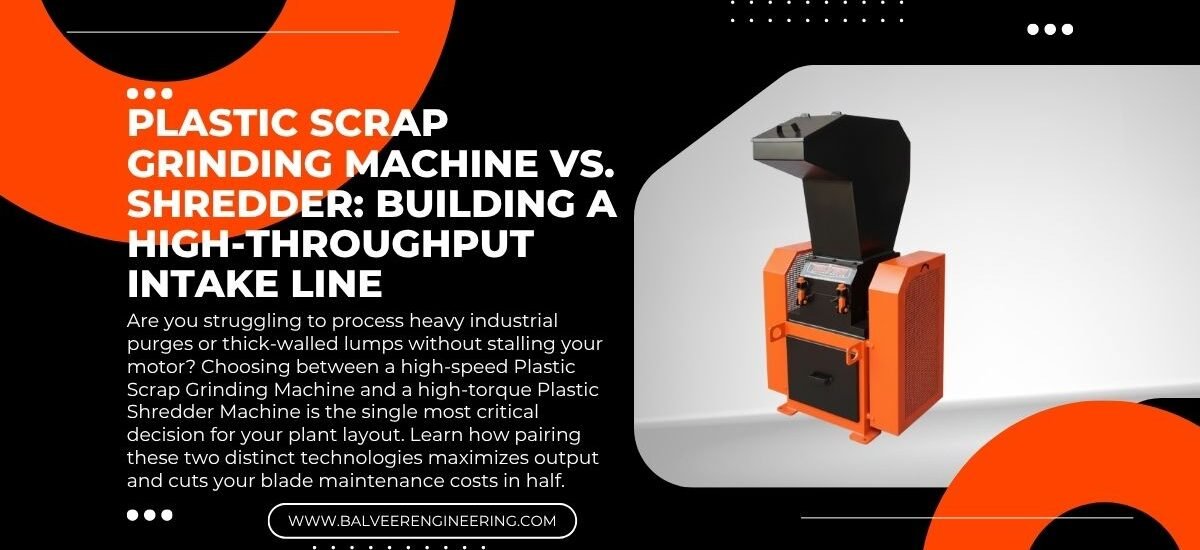
When designing the intake section of an industrial recycling facility, your first process is always size reduction. If your raw incoming material cannot be broken down efficiently into uniform pieces, your downstream washing, sorting, and drying lines will constantly starve for material.
To process diverse plastic waste streams profitably, you must understand the distinct operational roles of a heavy-duty Plastic Scrap Grinding Machine and a high-torque Plastic Shredder Machine. Using the wrong machine for the wrong material stream is the primary cause of premature blade wear and high energy bills.
1. The Plastic Shredder Machine: High Torque for Heavy Profiles
- Best Suited For: Massive injection molding purges, heavy-duty pipe sections, thick car bumpers, compressed plastic bales, and dense lumps
- How It Works: Low-speed, high-torque shafts pull the bulky material down into heavy-duty counter-rotating hooks or block cutters. Instead of cutting cleanly, it tears and shears the heavy plastic down into large, manageable chunks (typically 20mm to 50mm).
- The Major Advantage: It is nearly impossible to stall an industrial shredder with oversized pieces. It absorbs severe mechanical impacts without breaking shafts or burning out motors.
2. The Plastic Scrap Grinding Machine: High Speed for Precision Flakes
In contrast, a Plastic Scrap Grinding Machine operates at much higher RPMs. It uses a high-speed rotor lined with sharp knives that pass tightly against fixed bed blades, acting like high-velocity industrial scissors.
- Best Suited For: Thin-walled items, plastic bottles, crates, film scrap, profile trimmings, and pre-shredded material chunks.
- How It Works: As the material enters the cutting chamber, the high-speed rotor scissor-cuts the plastic continuously until the pieces are small enough to pass through a calibrated sizing screen underneath the chamber.
- The Product: It produces clean, sharp-edged, uniform plastic flakes (typically 6mm to 12mm) that are perfectly sized for friction washing and extrusion feed throats.
3. Comparing Operational Dynamics
| Operational Feature | Plastic Shredder Machine | Plastic Scrap Grinding Machine |
| Rotor Speed (RPM) | Low (typically 60 – 100 RPM) | High (typically 400 – 600 RPM) |
| Cutting Action | High-torque shearing and tearing | High-speed impact scissor-cutting |
| Tolerance to Metal | Moderate (heavy hooks can resist small tramp metal) | Very Low (metal will nick or shatter blades instantly) |
| Primary Output | Rough, large chunks (coarse size reduction) | Fine, uniform flakes (ready for processing) |
4. The Power Compound: Running in Tandem
For maximum processing ROI, the most profitable facilities do not choose between one or the other—they run them in a tandem configuration.
Feeding a massive, dense plastic purge directly into a high-speed grinder forces the blades to blunt rapidly and subjects the motor to severe amperage spikes. Conversely, trying to get a fine, clean flake out of a single shredder is highly inefficient.
The Ideal Workflow: Route your heavy, irregular scrap through a single-shaft or double-shaft shredder first to reduce the bulk material to coarse chunks. From there, use an automated conveyor line to feed those uniform chunks directly into your high-capacity grinding machine. This dual-stage processing layout double-insulates your line against machinery breakdowns, optimizes energy usage per ton, and extends your blade sharpening intervals by up to 300%.
Conclusion: Match the Tool to the Scrap Profile
Investing in the right size-reduction setup protects every downstream asset in your washing plant. Whether you need the brute force of a heavy shredder or the precision high-speed throughput of a grinding machine, balancing your intake capacity is the absolute bedrock of long-term operational success.



 Users Today : 12
 Users This Month : 556
 Total Users : 3477