

The Challenge: High Rejection Rates and Blade Failure
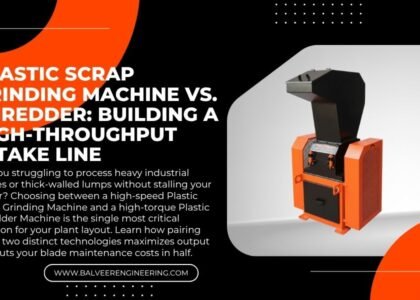
Whether you are operating a compact unit for processing small factory runners or running a heavy-duty Plastic Scrap Grinder Range from 6” to 55”, the condition of your cutting knives dictates your entire plant’s efficiency.
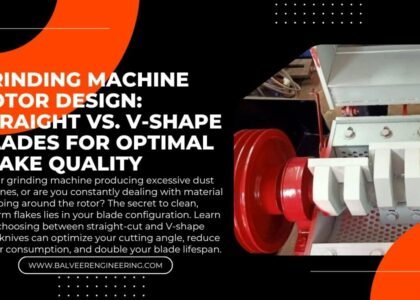
When your blades are sharp, your Grinder Machine operates like high-velocity industrial scissors, cleanly slicing plastic scrap into uniform, high-value flakes. However, when blades blunt, the mechanical action shifts from slicing to crushing. This creates excessive frictional heat, overloads your motor, and generates a massive volume of waste material in the form of fine dust.
1. Establish a Strict Sharpening Schedule
Don’t wait for your throughput to drop before checking your knives. Blade wear depends heavily on your material stream. For example, processing abrasive polymers in a PET Grinder or PET Crusher wears down edges faster than clean, rigid factory scrap.
- Visual Warning Signs: Look for rounded blade tips, microscopic cracks along the cutting edge, or an increase in irregular, jagged flakes in your discharge hopper.
- Amperage Monitoring: If your control panel shows that your motor is drawing more current than normal to process the same volume of material, your blades are dull.
2. Calibrate Rotor-to-Bed Blade Clearance
Every time you sharpen or change knives in your Plastic Shredder or grinder, you must reset the blade gap.
The Golden Rule of Clearance: The gap between the spinning rotor blades and the fixed bed knives must be perfectly uniform across the entire length of the cutting chamber. If the gap is too wide, thin materials like film or plastic labels will bend and jam the rotor. If it is too tight, thermal expansion during high-speed operation can cause the blades to strike each other, resulting in catastrophic internal damage.
3. Use Automated Auxillary Equipment to Reduce Manual Labor
Manually moving shredded material away from the machine can create operational slowdowns and safety hazards. Integrating automated material handling upgrades keeps your line running continuously while keeping operators safe.
- Grinder Machine with Cyclone Blower: Upgrading your discharge setup to a pneumatic cyclone system ensures that flakes are drawn out of the cutting chamber instantly. This continuous suction prevents material from staying in the chamber too long and overheating, while automatically sorting out airborne fines before they reach your storage area.
- SS 304 Hopper Machine feeding: Utilizing a heavy-duty stainless steel hopper ensures a smooth, rust-free gravitational flow of raw scrap into the cutting zone, preventing material hang-ups and ensuring a steady feed rate.
4. Anatomy of an Efficient Size-Reduction Assembly
[Raw Waste Intake] ➔ [SS 304 Hopper Machine]
│
▼
[Plastic Scrap Grinder]
(Precision Scissor-Cut)
│
▼
[Grinder Machine with Cyclone Blower]
(Instant Flake Evacuation)
│
▼
[Downstream Washing & Storage]
5. Protect Your Blades from Foreign Tramp Metal
The fastest way to destroy a brand-new set of knives is by letting a rogue bolt, wrench, or steel strapping wire enter the cutting chamber. While a Plastic Shredder uses low-speed, high-torque hooks that can tolerate small metal pieces, a high-speed grinder will experience instant blade chipping or rotor damage. Always install a high-intensity magnetic separator grid on your inlet conveyor to capture ferrous metals before they drop into the machine.
Conclusion: Maintenance is the Bedrock of Profitability
A well-maintained size-reduction line ensures clean flakes, low electricity bills, and consistent throughput. By implementing a daily check on blade sharpness and leveraging automated systems like a Grinder Machine with Cyclone Blower, you lock in your processing margins and extend the capital life of your machinery.



 Users Today : 12
 Users This Month : 556
 Total Users : 3477