
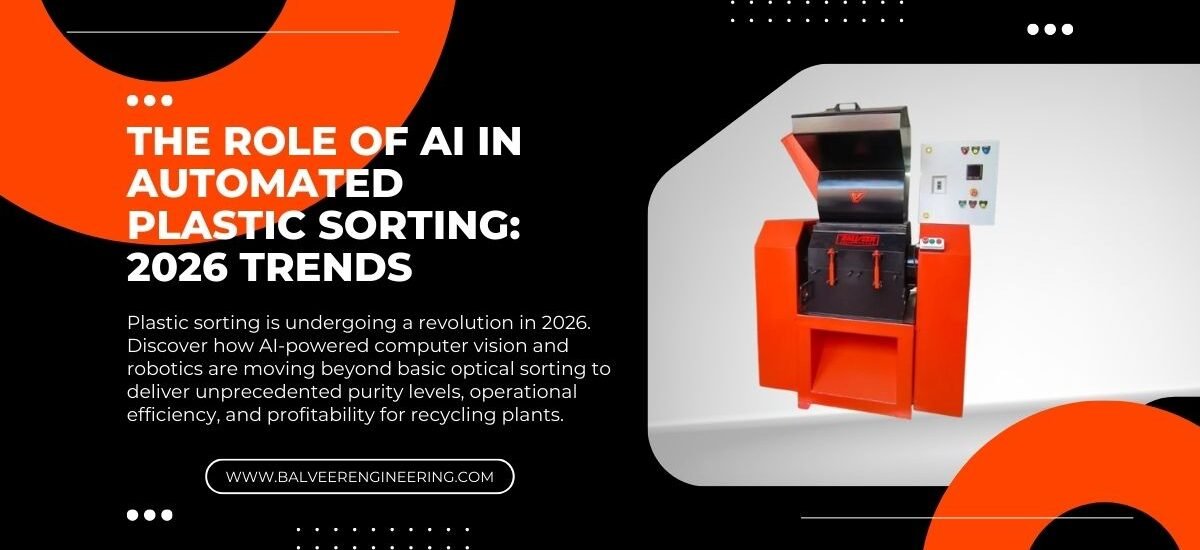
For decades, the “bottleneck” of the recycling industry has been sorting. Even with advanced mechanical systems, achieving the high purity levels required for food-grade packaging has been a constant struggle. By 2026, that is changing. The integration of Artificial Intelligence (AI) and computer vision is transforming the sorting floor from a labor-intensive manual process into a high-precision digital operation.
1. Beyond Color: AI's "Digital Brain"
Traditional optical sorters rely on basic color and near-infrared (NIR) sensors. While effective, they often fail when faced with complex items like multi-layer films or dark-colored plastics.
Today, AI-driven systems use Convolutional Neural Networks (CNNs) trained on millions of images. These systems can:
- Differentiate between food-grade and non-food-grade PET bottles.
- Identify brand logos and label types in milliseconds.
- Detect subtle textures and material variations that are invisible to the human eye.
2. The Rise of Fully Autonomous Sorting Halls
As we move through 2026, we are seeing a shift from “robot-assisted” sorting to fully autonomous sorting halls. In these facilities, AI doesn’t just pick items—it manages the entire material flow. By utilizing Digital Twins—virtual simulations of your physical plant—operators can test sorting strategies and throughput scenarios without ever stopping the line. This leads to reduced downtime and consistent, high-yield results.
3. Boosting Profitability Through Purity
The real-world benefit of AI sorting is simple: Purity equals Price. When your sorted bales contain 99% pure material, you move from selling “commoditized scrap” to “premium feedstock.” Recyclers using AI-enabled sorting are seeing efficiency gains of up to 60%, significantly lowering their cost-per-ton and maximizing the ROI of their equipment investments.
4. Predictive Maintenance and Operational Data
AI’s role isn’t limited to what happens on the belt. The data collected by AI sensors allows for Predictive Maintenance. By analyzing vibrations, motor temperatures, and belt speeds, the system can forecast equipment failure before it happens, allowing your maintenance team to replace a part during a scheduled break rather than dealing with an emergency shutdown.
Conclusion: The Future is Intelligent
The adoption of AI is no longer a luxury for large-scale facilities; it is becoming a competitive necessity. As regulatory requirements for recycled content increase, the ability to sort materials with extreme precision will determine which plants succeed in the next decade.




 Users Today : 5
 Users This Month : 549
 Total Users : 3470