
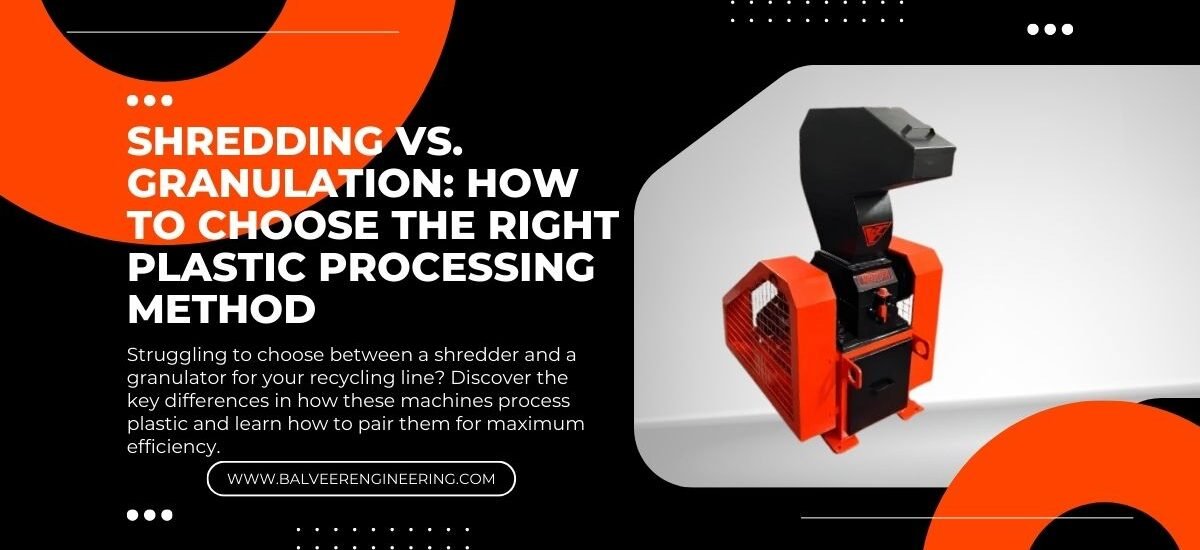
One of the most common questions we receive at Balveer Engineering is: “Should I be using a shredder or a granulator for my plastic waste?” While both machines are designed for size reduction, they operate on different principles and are suited for very different material streams. Choosing the wrong one can lead to machine jams, high maintenance costs, and poor output quality.
1. The Plastic Shredder: The "Heavy Lifter"
Shredders are designed to handle large, bulky, and heavily contaminated materials. They operate at low speeds with high torque.
- Best For: Purges, large drums, thick pipes, and bundled films.
- How It Works: The shredder uses a powerful, slow-moving rotor to “tear” material apart. It is robust enough to handle metallic impurities (like staples or labels) that would destroy a more delicate granulator.
- The Result: The output is typically large, irregular pieces. It is the perfect primary reduction step.
2. The Plastic Granulator: The "Precision Cutter"
Granulators (also known as granulating mills) are high-speed machines designed to produce a consistent, uniform flake size.
- Best For: Clean, pre-cut plastic, thin films, and scrap that has already been shredded.
- How It Works: Using a high-speed rotor with precision knives, the granulator “cuts” the plastic against a screen until it reaches the desired size.
- The Result: Highly uniform, high-purity flakes ready for extrusion or injection molding.
3. Which One Does Your Line Need?
In many high-efficiency recycling plants, you actually need both.
- Stage 1 (Shredder): Use a primary Industrial Shredder to break down large scrap into manageable pieces.
- Stage 2 (Washing): Send the shredded material through your Plastic Waste Dryer Machine to clean it.
- Stage 3 (Granulator): Use a granulator to achieve the perfect flake size for your extruder.
Key Considerations for Your Decision
- Material Contamination: If your scrap is dirty (e.g., post-consumer waste with rocks or sand), start with a shredder. A granulator is highly sensitive to abrasive contaminants.
- Desired Throughput: Granulators are faster for clean material, but shredders are essential for managing input volume.
- Output Quality: If you need specific flake sizes for a sensitive downstream process, a granulator is the necessary final step.
Conclusion: Matching Your Machine to Your Scrap
Don’t let a mismatch in technology hold back your production. Whether you are dealing with rigid lumps or thin film, the key is to match your equipment to the material’s physical state.

 Users Today : 5
 Users This Month : 549
 Total Users : 3470