
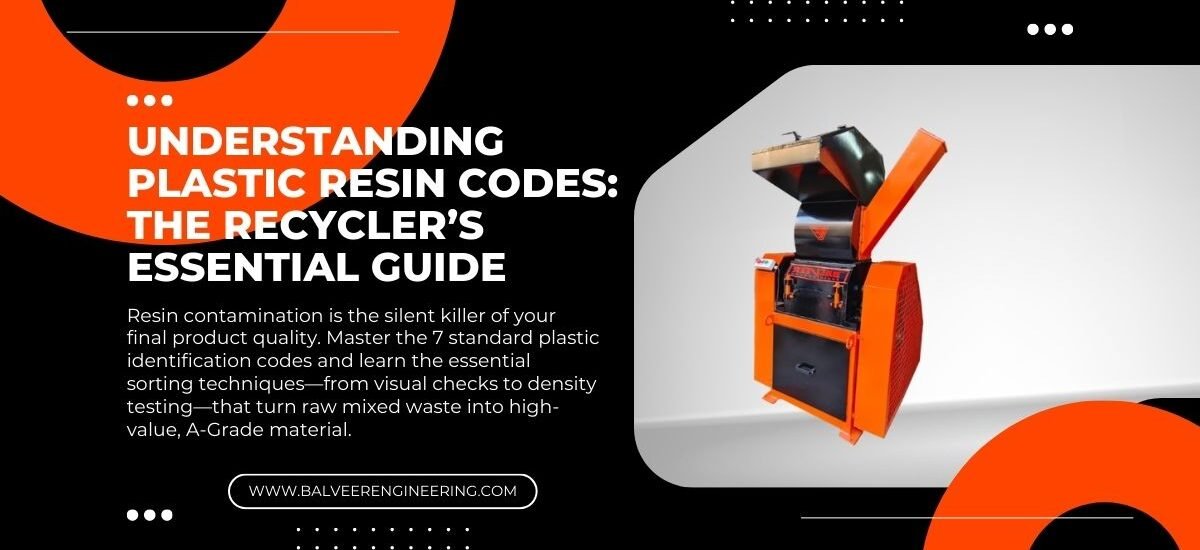
In the recycling industry, identification is half the battle. If you feed a batch of PET (Type 1) into a line optimized for PP (Type 5), your melt flow will be inconsistent, your extruder will struggle, and your final pellet quality will plummet.
For every plant owner, operator, and procurement officer, mastering the 7 standard plastic resin codes is the foundation of a high-yield recycling business.
The 7 Plastic Resin Codes Defined
| Code | Material | Common Usage | Processing Tip |
| 1 | PET / PETE | Beverage bottles, food jars | Requires high-quality washing to remove food residue. |
| 2 | HDPE | Detergent jugs, pipes | Excellent for high-speed granulation; handle with care for density. |
| 3 | PVC | Plumbing, medical tubes | Warning: Must be separated! Chlorine gas can damage machinery. |
| 4 | LDPE | Shopping bags, film | Requires specialized low-friction cutters to avoid “smearing.” |
| 5 | PP | Yogurt cups, bottle caps | High-heat resistance; ideal for consistent grinding and washing. |
| 6 | PS | Foam cups, cutlery | Very brittle; requires precise screen sizing to avoid excess “fines.” |
| 7 | OTHER | Multi-layer, PC, Acrylic | Complex material; usually requires high-torque shredding. |
Why Identification is Your First Line of Defense
- Protecting Your Machinery: As we mention in our Machine Maintenance guides, processing the wrong material can lead to “melt-on-blade” syndrome, which can destroy your Industrial Plastic Grinder blades within hours.
- Maximizing Market Value: Contamination of your flake stream with a different resin code is the #1 reason batches are rejected by buyers. Using an automated Sorting System combined with manual spot-checking for codes ensures “A-Grade” purity.
- Compliance & EPR: As global EPR regulations tighten, having a clear, documented material identification process is essential for traceability.
Pro-Tips for Accurate Sorting
- The “Float-Sink” Test: Many resins (like PE and PP) float in water, while PET and PVC sink. This is a low-cost, effective way to verify your batches.
- Visual Inspection: Don’t rely solely on the symbol. Check for the “molding seam” on the bottom of containers—this often indicates the material type more accurately than a potentially misleading label.
- Dedicated Lines: If your plant volume justifies it, separate your lines by resin code. A dedicated line for PET significantly reduces the risk of cross-contamination from PP or HDPE.
Conclusion: Knowledge is Your Best Tool
Identifying your plastic scrap isn’t just a basic step—it’s a high-level operational strategy. By training your team to respect these resin codes, you reduce machine downtime, minimize waste, and command higher prices for your high-purity output.


 Users Today : 5
 Users This Month : 549
 Total Users : 3470