
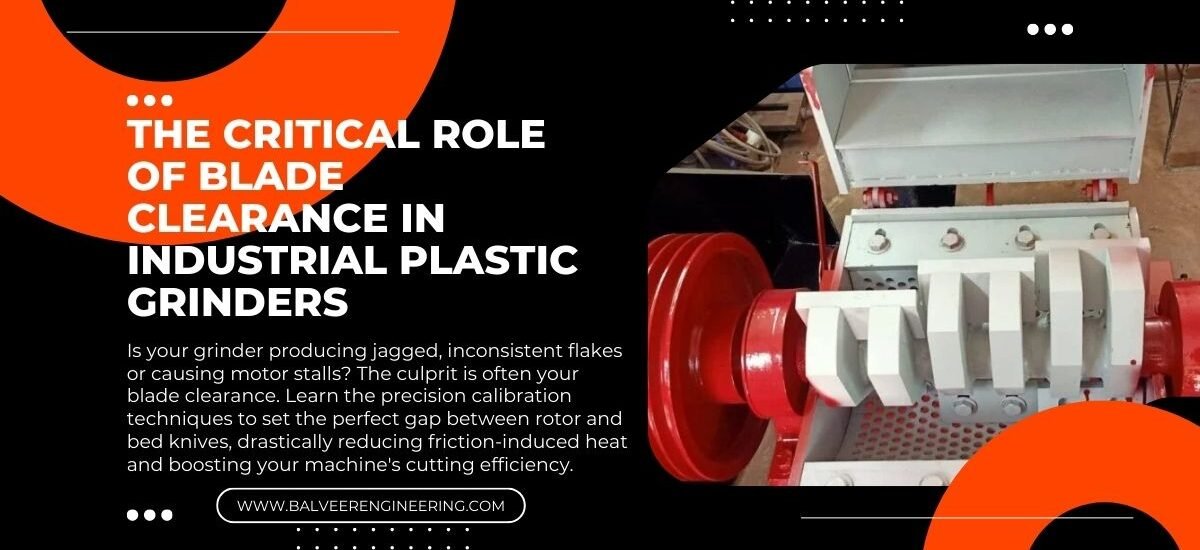
In the world of industrial plastic processing, most operators focus on sharpening blades, but they often ignore the most important factor in machine health: Blade Clearance.
Correct clearance—the precise gap between the rotor knife and the bed knife—is the difference between a clean, energy-efficient cut and a machine that is tearing, melting, and stalling.
1. Why Clearance Matters
If the gap is too wide, the grinder won’t cut the plastic; it will “fold” or “smear” the material between the knives. This causes three immediate problems:
- Energy Spikes: Your motor has to work twice as hard to push the material through.
- Excessive Heat: Friction creates heat, which causes plastic to become tacky, leading to clogs in your Plastic Waste Dryer Machine.
- Inconsistent Flakes: Instead of clean, uniform cuts, you get jagged, inconsistent pieces that are difficult to process downstream.
2. The "Goldilocks" Gap
Every Industrial Plastic Grinder has a manufacturer-recommended clearance range (typically measured in millimeters).
- Too Tight: Risk of metal-on-metal contact. Even a tiny piece of stray grit or metal can chip your expensive hardened-steel blades.
- Too Loose: Loss of cutting efficiency, leading to higher electricity consumption.
3. Step-by-Step Calibration (General Practice)
- Lockout/Tagout: Never perform maintenance on a powered-on machine.
- Clean the Surfaces: Use a wire brush to remove any residual plastic buildup from the rotor and bed knives.
- Measurement: Use a feeler gauge to measure the gap uniformly across the entire length of the blade.
- Adjustment: Gradually tighten the adjustment screws to reach the manufacturer’s specification, ensuring the gap is perfectly parallel from one end of the blade to the other.
Note: Always consult your specific machine manual first.
4. When to Re-calibrate
Don’t wait for your flakes to look like “shredded paper” before checking your clearance.
- After every blade sharpening: The blade geometry changes slightly after sharpening; re-calibration is mandatory.
- After high-impact incidents: If your grinder accidentally ingests a foreign object, perform an immediate clearance check.
- Routine Schedule: We recommend a clearance audit every 200–300 operating hours to maintain peak machine performance.
Conclusion: Precision is Profit
Fine-tuning your blade clearance is a “low-cost, high-reward” maintenance task. It reduces the load on your motor, saves on electricity, and protects your blades from premature wear. Treat your grinder with precision, and it will return the favor with consistent, high-value output.




 Users Today : 12
 Users This Month : 556
 Total Users : 3477