
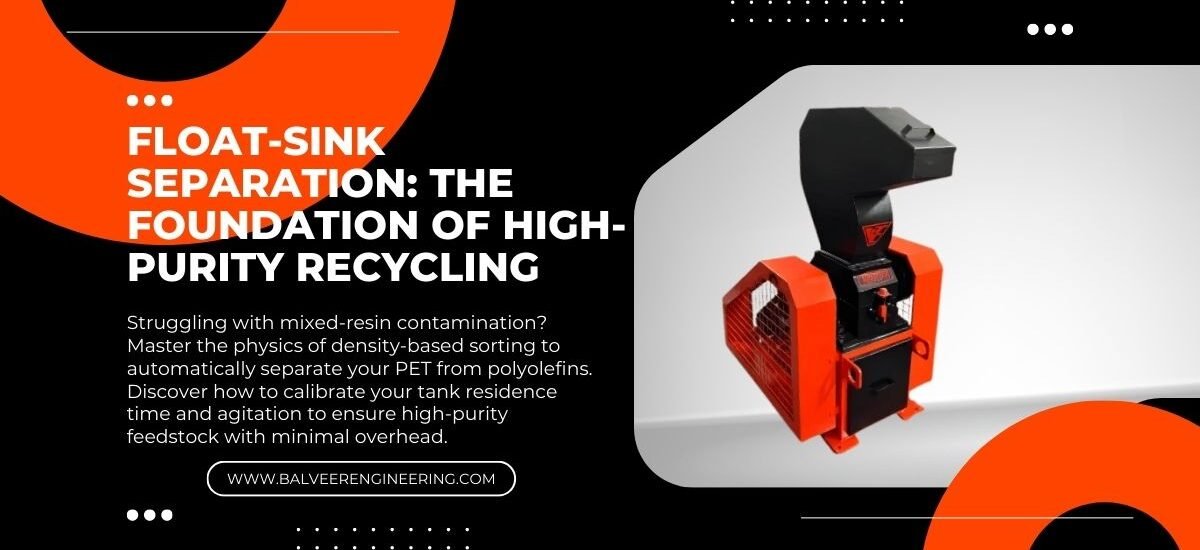
In the recycling industry, the simplest solutions are often the most effective. When it comes to sorting mixed plastic streams, few methods match the reliability and cost-efficiency of Float-Sink Separation.
Whether you are running a PET bottle line or processing rigid mixed plastics, understanding how to leverage the density of materials is the first step toward producing “A-Grade” feedstock.
1. The Core Principle: Density as a Tool
The float-sink process relies on a simple law of physics: Specific Gravity. * If a material has a density lower than the liquid medium (typically water, density ~1.0 g/cm³), it floats.
- If the material has a density higher than the liquid medium, it sinks.
By using this basic principle, you can automatically separate entire classes of plastics without complex sensors or expensive robotic sorters.
2. Common Plastic Densities
To implement this effectively, you need to know where your plastics sit in the water column:
| Plastic Type | Typical Density (g/cm³) | Behavior in Water |
| PP (Polypropylene) | 0.90 – 0.91 | Floats |
| LDPE | 0.92 – 0.94 | Floats |
| HDPE | 0.95 – 0.97 | Floats |
| PS (Polystyrene) | 1.03 – 1.07 | Sinks |
| PET | 1.35 – 1.39 | Sinks |
| PVC | 1.16 – 1.45 | Sinks |
3. Practical Applications in Your Plant
- PET Recycling: After shredding, PET bottles become a mix of PET flakes (which sink) and PP/PE caps and labels (which float). A sink-float tank is the primary tool used to remove this contamination, ensuring your PET flakes are pure enough for high-value applications.
- Mixed Rigid Plastics: If you are processing a blend of rigid containers, you can adjust the density of the liquid medium by adding salts (like calcium chloride) to separate plastics that otherwise have similar behaviors in pure water.
4. Maximizing Your Tank’s Efficiency
A tank is only as good as its design. To get the most out of your setup:
- Residence Time: Ensure your tank is long enough. Plastic pieces need time to become fully “wetted” and sink. Short, rushed tanks lead to high cross-contamination.
- Mechanical Agitation: Use top-rotating paddles to keep floating material moving and bottom screw conveyors to continuously remove the sunken fraction.
- Water Filtration: Closed-loop water recirculation, paired with a filtration system, saves water and keeps the process steady by maintaining a consistent density.
Conclusion: Simple, Scalable, Smart
Float-sink separation is the backbone of a successful washing line. It is affordable to operate, easy to maintain, and highly scalable as your plant grows. By mastering the density profiles of your incoming scrap, you can maintain high purity levels even with diverse, comingled waste streams.



 Users Today : 9
 Users This Month : 553
 Total Users : 3474