
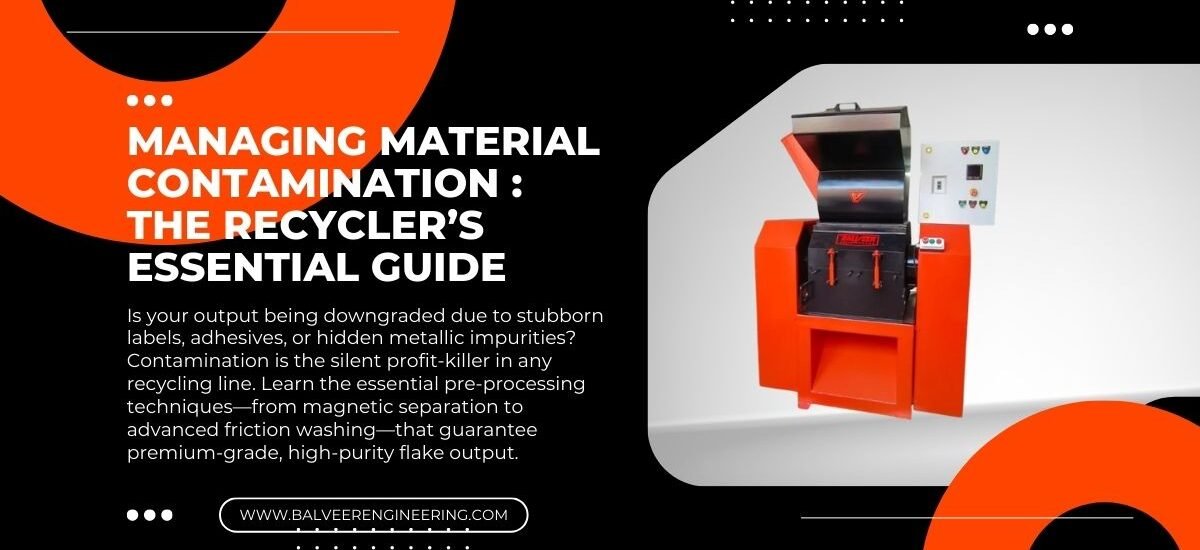
In the recycling business, purity is the currency. Buyers pay a premium for consistent, clean feedstock, while contaminated batches often face rejection or deep price discounts. When your Industrial Plastic Grinder processes material, it doesn’t distinguish between high-quality plastic and a rogue piece of metal—it shreds both.
1. Identify the Three Types of Contamination
To manage it, you must categorize it:
- Metallic Impurities: Staples, wire, or hidden screws. These are the most dangerous and can shatter your knives in seconds.
- Organic/Residue Contamination: Food, oil, grease, or paper labels. These cause odors and degrade the quality of your melt during extrusion.
- Polymer Cross-Contamination: The presence of PP in a PET stream. This is usually the hardest to detect but the most detrimental to final product structural integrity.
2. The Multi-Stage Removal Defense
A high-ROI plant uses a “layered” approach to contamination removal:
- Magnetic Separation: Install high-intensity magnetic plates over your feed conveyor. This is your first and most vital defense against tramp metal.
- Air Density Separation: Use air-elutriation systems to blow off lightweight paper, dust, and thin-film labels before they ever reach the grinder.
- Friction Washing: For organic residue, a high-speed friction washer is non-negotiable. It uses high-velocity water and mechanical scrubbing to peel away label adhesives and food particles from the flake surface.
3. The Impact on Downstream ROI
When you prioritize contamination management, you aren’t just “cleaning plastic”—you are protecting your entire production chain. By ensuring your flakes are pure:
- Extruder Life: You prevent screen-pack clogging and extend the intervals between extruder filter changes.
- Energy Consumption: You reduce the load on your heaters and motors.
- Market Premium: Clean flakes are “drop-in” ready for high-value applications like packaging, which commands a higher price per ton than low-grade, contaminated scrap
Conclusion: Purity Starts at the Intake
Don’t wait for contamination to reach your final product. By implementing robust pre-sorting and automated removal systems early in the line, you transform your recycling facility into a high-precision manufacturing plant.

 Users Today : 5
 Users This Month : 549
 Total Users : 3470